Showing posts with label Photos. Show all posts

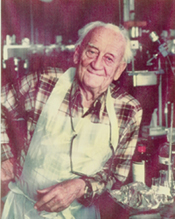
Albert Szent-Györgyi Biography | Photos | Images | Wallpapers | Pictures


Name:Albert von Szent-Györgyi
Birth Date:September 16, 1893
Death Date:October 22, 1986
Place of Birth:Budapest, Hungary
Place of Death:Woods Hole, Massachusetts, United States
Nationality:American
Gender:Male
Occupations:biologist, chemist


In 1893, Albert Szent-Györgyi was born in Budapest, Hungary, into a family of noted scientists. During World War I, he spent several years in the Austrian army but, although decorated for bravery, became increasingly convinced the war was a senseless one. Deliberately wounding himself, he returned to his studies and obtained his medical degree from the University of Budapest in 1917. A year later--in large part because the Austrian defeat left his family financially strained--Szent-Györgyi decided to seek further training in other countries. Restless and intellectually curious, he worked and studied in Berlin, Germany, the Netherlands and at the Mayo Clinic in the United States. Finally, in 1927, he obtained his Ph.D. at England's Cambridge University.
At Cambridge, Szent-Györgyi worked in Frederick Gowland Hopkins' laboratory and, for a time, concentrated on trying to determine the function of the body's adrenal gland. During that period, in an odd roundabout way, the restless scientist suddenly found himself taking up a new interest: fruits and vegetables. He had already noticed that when someone acquires Addison's disease, which causes the adrenal gland to wither, brownish spots typically appear on the patient's skin. These spots, he felt, were surprisingly similar to the brown spots that appear on plants damaged by oxidation. Intrigued, he asked himself: could oxidation affect the tissue of humans in the same way it affected that of plants"

To answer his own question, Szent-Györgyi first studied plants, like potatoes, that invariably turn brown when exposed to too much oxygen. Then he turned his attention to plants that did not turn brown in similar situations, suspecting that they might possess some kind of antioxidizing substance. Sure enough, Szent-Györgyi not only found such a substance in both oranges and cabbages, but he also found an identical substance in adrenal glands. Because the substance's molecule seemed to possess six carbon atoms, he named it hexuronic acid.

For several years, while working on other projects, Szent-Györgyi continued to investigate his newly discovered substance, (even sending a portion of it to his friend and fellow chemist Walter Norman Haworth (1883-1950), who was eventually to identify vitamin C's chemical structure). But not until 1931--when he had returned to Hungary and joined the faculty of the University of Szeged--could he devote his full attention to it. That year, working with a young American associate, S.L. Svirbely, he discovered that the substance had considerable antiscorbutic effect--it could, in other words, both prevent and counteract scurvy. For further research, though, he needed enormous amounts of the hexuronic acid, and he could no longer afford the sources he had been using. Almost in desperation, he turned to one of Hungary's best-known exports, the paprika, a fruit in the red pepper family. And to his intense relief, paprika proved to be an exceedingly rich source of the acid. With ample supplies at his disposal, Szent-Györgyi was able to prove that, as he had long suspected, hexuronic acid was really vitamin C. (He published his findings in 1932, just two weeks after an American team of researchers, headed by Charles G. King, made a similar announcement.) Szent-Györgyi and Haworth, decided to rename the acid, which from then on was called ascorbic acid.

For a few more years, Szent-Györgyi continued to study the activity of ascorbic acid in the body. His researches eventually led him to the isolation of a new catalyst that he called cytoflave and which was later identified as vitamin B2 or riboflavin. He also began an intense investigation into the oxygen uptake of minced muscle tissue, his work laying the foundation for the elucidation of the citric acid cycle by Hans Krebs.

For his various research projects, particularly those relating to vitamin C, Szent-Györgyi received the Nobel Prize in physiology or medicine in 1937. Later, the scientist switched his studies to the biochemical processes involved in muscle contractions. Active in the anti-Nazi underground during World War II, he was ordered killed by Adolf Hitler (1889-1945) himself, but was saved by friends who brought him to the Swedish Embassy (neutral territory in those days). He remained there until the danger passed. In 1947, he decided to immigrate to the United States and was immediately offered a position at the Marine Biological Laboratories at Woods Hole, Massachusetts.


Alexander Calder | Photo Shoot | Photos | Pictures | Images | Rare Photos


I have decided to start an ARTIST MONDAY section, where I post images an inspirational artist on the blog every week. I shall start with Calder ((1898-1976), whose illustrious career spanned much of the 20th century, and is the most acclaimed and influential sculptor of our time. Calder utilized his innovative genius to profoundly change the course of modern art. He began by developing a new method of sculpting: by bending and twisting wire, he essentially "drew" three-dimensional figures in space. He is renowned for the invention of the mobile, whose suspended, abstract elements move and balance in changing harmony.

Asami Tani Hot Pictures,Wallpapers,Images,Photos

[asami-tani-1.jpg]
Name : Asami Tani
Born : 1982-6-12
Height : 157cm
Measurements : Bust 87cm,Waist 56cm,Hip 82cm

Kawano Riko Hot Picture,Wallpapers,Images,Photos

[kawano-riko-1.jpg]
Riko Kawano was born on 13 March 1988 in Tokyo, Japan. This 150cm beauty is aJapanese AV and gravure Idol. She started way back in 2004 and have 2 DVDs to her name to-date. This cutie enjoys cooking and reading during her free time.

150LP Push-up/ Y-string Picture,Photos,Images,Bikini

[99_99990.jpg]

[IMG_3035.jpg]

[IMG_3074.jpg]

[IMG_3081.jpg]

*Night Drive through Moscow: Where Tourists Go | St. Basil's Cathedral | Events | Wallpapers | Pictures | Photos | Images*

Christ the Savior Cathedral Moscow


The "Night Drive through Moscow" series is the result of my four hour drive through the city of Moscow on January 6, Russian Orthodox Christmas Eve. There will be three picture posts representing what you can see in Moscow in four hours on a winter night: this one named "Where Tourists Go"; on Wednesday - "View from a Car Window"; and on Friday - "Where People Live and Work."
The tourist photos are self-explanatory; actual tourists would go to many more places in the city if they had enough time on their hands. The "Car Window" photos were taken literally from a car window -- they will portray things you might not expect to see in Moscow --freeways, casinos, Rolex banners and nice cars. "Where People Live and Work" will contain photos of condos, hotels and office buildings. Remember that this year winter is extraordinary warm and does not represent a usual Russian winter time; usually the streets and roofs are covered with snow.
I was able to visit this many places because the city was empty of cars and people -- everyone was getting ready for a family dinner or attending service at a church. On a work day or holiday shopping night a four mile drive can take two hours. On the night of December 22, when Russians were consumed with holiday shopping, I got stuck in one of these traffic jams. I had to ditch my car on the side walk and come back for it at midnight, only to get caught in another traffic jam on the way home -- it took me an hour to drive five miles at 1 a.m.!
Enjoy the photos in the extended post. Please expect the extended post page to take some time to upload due to the number of photos.
red-square-gum-st-basils-ca.jpg
Red Square - view from the distance: Kremlin, GUM, St. Basil's Cathedral
christ-the-savior-river-vie.jpg
Christ the Savior Cathedral - view from a bridge
christ-the-savior-river-zoo.jpg
Christ the Savior Cathedral - close-up...
kremlin-wall-moscow-river.jpg
Kremlin Wall - view from a bridge
kremlin-wall-moscow-river-c.jpg
Close-up...
kremlin-pedestrian-entrance.jpg
Kremlin: tourist entrance
st-basils-cathedral.jpg
St. Basil's Cathedral
motorola-st-basils-cathedral-1.jpg
St. Basil's Cathedral - made of Motorola cell phones...
motorola-st-basils-closeup.jpg
Close-up...
kremlin-dvoryansky-dvor.jpg
Manezhnaya Square - view of Dvoryansky Dvor building (Russian nobility "club house" later the Museum of Lenin) and glass domes of the underground shopping mall
kremlin-manezh-glass-domew.jpg
Manezhnaya Square: Dome of the underground shopping mall
red-square-christmas-tree.jpg
Christmas tree in Red Square
red-square-dvorynasky-dom.jpg
Dvoryansky Dom - view from Red Square
red-square-lenins-tomb.jpg
Lenin's tomb (on the right) and Kremlin buildings - view from Red Square
red-square-main-tower.jpg
Kremlin tower - view from Red Square
red-square-gum.jpg
GUM - view from Red Square
gum-inside.jpg
Gum - inside the mall
tourist-t-shirts.jpg
Tourist souvenirs sold near Kremlin: Cold War stereotypes might still scare those who have never been to Russia, but make a great gift to others and good income for the store-owners...
kremlin-car-entrance.jpg
Kremlin driveway: where Putin goes to work...
russian-federation-parliame.jpg
Building of the Russian Duma (Parliament) - it's nothing special
spivakov-concert-dom-muziki.jpg
Mozart concert conducted by Vladimir Spivakov at Dom Muziki (House of Music - the new performance hall in downtown Moscow); this photo was taken on a different night; a tourist should definitely try to catch a show for the experience
kremlin-southern-tower.jpg
Kremlin's southern tower - I don't remember the names of each tower, so please just enjoy the view
kremlin-southern-wall.jpg
Kremlin's southern wall along the bank of the Moscow River
kremlin-tower.jpg
Kremlin - view from the northern side
christ-the-savior-1.jpg
Christ the Savior Cathedral - originally built between 1839 and 1860 to celebrate the Russian victory over Napoleon. In 1931 the Soviet government dynamited the cathedral to rubble. It was rebuilt between 1996 and 2000.
christ-the-savior-2.jpg
On the night of Russian Orthodox Christmas Eve
christ-the-savior-inside-1.jpg
Beautiful interior of Christ the Savior Cathedral - the result of an enormous reconstruction effort
christ-the-savior-inside-2.jpg
Main Altar
christ-the-savior-inside-3.jpg
The shiny yellow objects and icons are real gold leaf
christ-the-savior-inside-4.jpg
Please visit the official cathedral English language website for more information
christ-the-savior-inside-5.jpg

kremlin-wall-cathedrals.jpg
View of the Kremlin from the banks of the Moscow River
motorola-st-basils-cathedral-2.jpg
Again Motorola
st-basils-cathedral-kremlin.jpg